Mahjong Tips and Tricks - Things To Remember
 Jacob Mitchell
Mahjong isn't just a game of luck; it requires players to master the rules and develop effective strategies. However, most players overlook a critical element. Once you've learned the basics of Mahjong, the next crucial step is to understand the key tips and tricks.
In this guide for Pakistani players, we'll share the Mahjong tips and tricks we know, so you don't have to worry. Let's dive in without further ado!
Devise a Plan Before You Play Mahjong
Before you start playing your Mahjong session in Pakistan, it's vital to have a clear plan. As soon as you see a tile, start thinking about your next move. The ideal first step is to decide which tiles you'll pick up, which ones you'll wait for, and which ones you want to discard from your hand.
- Remember, your opponents are constantly observing what you place on the table.
- For experienced Mahjong players, the tiles being discarded offer a clear indication of what their opponents hold, allowing them to strategize effectively. Savvy players can leverage this knowledge to their advantage.
- Be mindful that bluffing isn't always the best tactic, as it can reveal your hand and give your opponents valuable insights.
Getting to Know the Mahjong Tiles
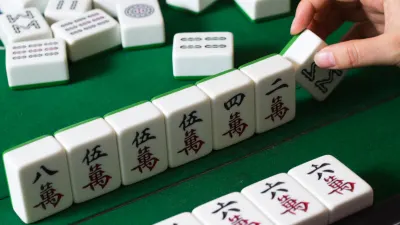
You can't effectively form meld sequences if you're unsure which tiles match. For those unfamiliar with Chinese characters, this can be quite a challenge. Consider using a Mahjong set that includes Arabic numerals alongside the traditional symbols on mahjong tiles. This way, you won't need to decipher intricate calligraphy to find the tiles you're looking for.
Should You Skip the First Throw?
Skipping the first throw can be a clever strategy in Mahjong as it avoids revealing your intentions to opponents, potentially giving you an early advantage in the game.
However, a downside to this tactic is that it might inadvertently hint at your Mahjong winning strategy for that round. If your opponents are keen to win, they'll likely infer your strategy from your actions. Even if you were close to forming a set with that throw, your opponents might become more cautious with subsequent throws, making it harder for you to secure another set.
- Discarding that early throw might signal to opponents that you are still learning the game, a vulnerability they could exploit.
- Don't get too hung up on not receiving discarded tiles; you're always free to let them go.
- In Mahjong, players may use a variety of tiles; they simply need to wait for the right moment to assemble a strong hand that will guarantee victory.
Skipping the Gaps
Avoiding gaps between the tiles when arranging the rack is one of the best mahjong tip methods. Because mahjong players are very perceptive, maintaining gaps might reveal a player’s strategy. They are able to quickly identify the hand a player is attempting to put up and their potential actions.
To line up their tiles in combinations and determine their next movements, some new players would create a gap. Yet, it also implies that other players can use their hands similarly. Placing tiles that are not connected and leaving gaps might confuse opponents. But, doing so is only advised when a player is certain they won't become perplexed by their own tactics.
Appropriate Scoring
For new players, it is better to keep the scoring as simple as possible. If not, it could mess up their game, and they might not be able to win. The easiest approach to scoring the game is to award one point to the person who completes the first mahjong, and zero points to everyone else. Add up the points, and the one who wins the most games is declared the winner.
Players can use the other Mahjong scoring guidelines if they have a better grasp of the game. The regulations of the Chinese Official Mahjong Competition are similar to many of them. After that, they can experiment with more challenging scoring systems, such as those for Hong Kong or Ricchi Mahjong.
Point Values of The Tiles
It's also a good idea to remember that pongs have a higher point value than chows. Chows are only useful when there are four of them available to form a mahjong. Yet, making pongs rather than chows may seem counter-intuitive, particularly if a player has experience of playing poker.
- Pong is equivalent to a three-of-a-kind in poker, while chow is nearly identical to a straight.
- While chows are valued more in poker, a player could be inclined to concentrate on them, but mahjong games have distinct hand rankings.
- If new mahjong players learn the various meld combinations and take into account the point values for each, they will make fewer mistakes and advance more quickly.
Hiding the Melds
A player will get more points by keeping the melds a secret until they are prepared to declare mahjong. Therefore, they shouldn't reveal them until absolutely necessary. Mahjong beginners frequently like moving their tiles around to observe which melds they are effectively working on. Players are free to move their tiles about, but they should try to keep them all in a row.
- It is simple for the adversaries to see what a player is working on when full melds are separated, or certain tiles are set aside, so they will modify their mahjong strategy appropriately.
- A player becomes a more difficult mahjong opponent to play against by maintaining a straight row of tiles.
Discarding the Tiles
Although it may be tempting, it is not a good idea to discard any tiles a player has in their hand that don't fit. Instead, a player should focus on the tiles that their rivals are tossing away.
When a player pays close attention to the discard pile, they increase their chances of finding the discards they require and decrease their chances of accidentally discarding them into another player's mahjong hand.
What would be the wisest course of action if a player had many tiles to discard? If you are certain that your opponents won't desire them, it would be best to discard the tile that is most near other tiles that have previously been discarded.
Sticking To A Pair
A pair is a hand that every player should keep close. These are among the most adaptable tiles. A player can adhere to them as pairs or use them to form a four-of-a-kind (Kong), a three-of-a-kind (Pung), or a group of three identical tiles (Chow).
- Don't try to shatter them if they have a pair or two for this reason. In reality, when a player advances in the game, they can turn out to be their winning tiles.
- It's important for a player to promptly implement their mahjong-winning techniques.
Conclusion
To learn mahjong completely, there are some tips and tricks that a player must remember. Without them, a player would never be complete with other players, as many of them observe the game and figure out others’ strategies as well.
Frequently Asked Questions
Are there any strategies to improve my Mahjong game in Pakistan?
Indeed, several strategies can enhance your Mahjong skills. Consider these:
- Begin with a well-thought-out strategy.
- Familiarize yourself with the tiles.
- Consider skipping the initial discard.
- Prioritize building a strong foundation.
What's the key to success in Mahjong?
While there's no guaranteed "secret," a balanced approach is crucial. Guide your hand purposefully, yet remain adaptable. Avoid aimless tile collection; patience and strategic thinking are your greatest assets in Mahjong.
What constitutes the ultimate hand in Mahjong?
An ideal Mahjong hand typically comprises four sets (chow, pung, or kong) and a pair.
Is it possible to win with seven pairs in Mahjong?
Winning with seven pairs presents a unique challenge. The limited ways to complete the hand reduce your odds. Furthermore, you must rely solely on your own draws, as you cannot claim tiles from other players to form these pairs.
What is the significance of the 13 Wonders in Mahjong in Pakistan?
The "13 Wonders" hand is considered one of the most exceptional and challenging to achieve in Mahjong. The probability of winning with this hand is approximately 1 in 2464.
Is it permissible to use four jokers in Mahjong?
Jokers can be used in exposed pung, kong, or quint formations. However, claiming a discarded tile for a single or pair using a joker is generally not allowed, unless it's the final tile needed to declare Mahjong.